
HALLOWEEN TRAIL at The HOLLIES
Monday 26 October 2026
Entries close TODAY!

6 upcoming events
Next event:
27/10/2026 Fun Care & Pony Day Tuesday 27th October at Queen Mary's School Open to All
Find out more ..
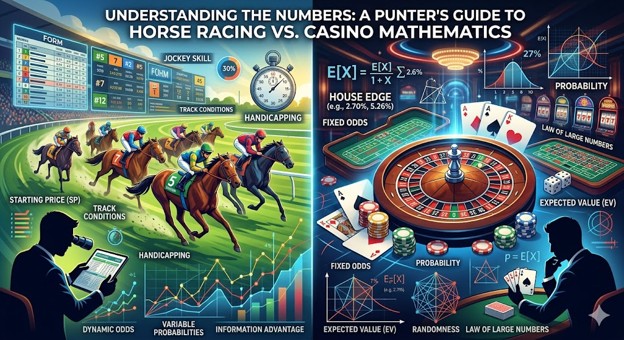
Risk is not a monolith. The environment dictates the mathematics. The mathematics dictate the outcome. A punter standing trackside calculates risk through a chaotic lens of subjective variables, dynamic market forces, and peer-to-peer liquidity. A bettor on a casino floor faces an entirely different reality. Casinos operate on rigid mathematical constants. Probability here is known. It is absolute. It is immutable.
Every wager is a continuous negotiation between financial risk, potential reward, and statistical probability. Knowledge of how different operators secure their profit margins is the only way to accurately assess that risk. This analysis strips away the romance of gambling. It exposes the raw mathematical engines driving both fixed-probability casino gaming and fluid betting markets.
Casino gaming is deterministic probability in its purest form. Physical constraints or software algorithms govern the outcomes strictly. The spin of a wheel and the draw of a card are statistically independent events. External variables do not matter. Participant strategy cannot change the underlying math. The casino never relies on market forces to secure a profit. It relies heavily on the Law of Large Numbers and a structural advantage.
This advantage is the house edge. It represents the casino's expected profit as a strict percentage of the wager. Operators do not build this edge by manipulating probability. They engineer it by paying winning bets below their true mathematical likelihood.
Look closely at the payout structures within the Roulette category as a direct comparison to trackside bookmaking. A standard European wheel has 37 numbered slots. The true probability of hitting a single number is exactly 1 in 37. A mathematically fair payout would be 36 to 1. The casino pays 35 to 1.
That single-unit discrepancy defines the house edge. This discrepancy guarantees the operator’s margin across all 37 outcomes. Expected Value quantifies this mathematical disadvantage. Short-term variance always converges on true probability. An even-money wager on a European layout covers 18 numbers. The calculation is brutal. An infinite timeline guarantees an average loss of two dollars and seventy cents for every hundred dollars wagered. The long-term expected return caps at ninety-seven percent.
American wheels add a double-zero pocket. The probability of hitting a specific number drops. The payout remains a static 35 to 1. The house edge nearly doubles. Triple Zero wheels push this edge to a punishing extreme. The expected return crashes to ninety-two percent. High-volatility inside bets and low-volatility outside bets carry the exact same negative expected value.
Casino games lack memory. Each trial is independent. Variance allows for short-term profits. A player might get lucky. The Law of Large Numbers inevitably crushes those anomalies. The probability of avoiding a zero pocket decays rapidly over multiple spins. This mathematical decay destroys structured betting systems. The Martingale system simply swaps frequent small wins for catastrophic losses. A negative expected value applies to every individual wager. Bet size does not alter this reality. The house edge is an insurmountable constant.
Sports and racing bookmakers operate in a different reality. They do not have a mathematically guaranteed edge. They deal entirely in subjective probability. The true likelihood of a horse winning is fundamentally unknowable before the race begins. Bookmakers rely on synthetic margins overlaid onto dynamic odds to secure operational profit.
They use implied probability and the overround. Market odds represent an implied mathematical likelihood of a specific outcome. A bookmaker prices all outcomes so the sum of implied probabilities artificially exceeds one hundred percent. The excess percentage is the overround. This represents theoretical profit if money is evenly distributed across all runners. Horse races routinely carry book percentages between 110 and 125 percent.
Accumulators compound this margin geometrically. A standard four-leg bet generates a massive combined overround. Bookmakers deliberately exploit the favorite-longshot bias. They inflate margins on low-probability wagers. Recreational punters chase these high payouts. Actual bettor loss rates exceed theoretical mathematical predictions by up to forty percent. This deliberate pricing inefficiency drives bookmaker profitability. It capitalizes on the public's poor assessment of low-probability variables.
Pari-mutuel betting eliminates house exposure entirely. Participants bet directly against each other. A dynamic, peer-to-peer liquidity market forms. The track operator acts strictly as a market facilitator. They deduct a predetermined administrative fee known as the takeout. They distribute the remaining pool proportionally among winning tickets. The house cannot lose money.
Payouts are intrinsically dynamic. Final odds are not crystallized until the betting gates officially close. A participant's potential reward fluctuates continuously based on the collective capital flow. The track deducts the gross commission from the total aggregate pool. The remaining net pool dictates the final payout ratios.
Exotic wagers drastically alter this math. Bets requiring exact sequential finishes offer geometrically lower probabilities of success. They attract significantly higher takeout rates from the track. They distribute massive payouts from a single price pool. These payouts rival progressive slot jackpots. They remain grounded in applied statistical probability rather than algorithmic random generation.
Casino math involves perfect, useless information. Perfect knowledge of wheel dimensions offers zero strategic advantage. Horse racing relies on an imperfect, highly fluid information market. It is a skill-based domain. Punters analyze equine pedigree, track conditions, and trainer intent to model true probability.
Professionals hunt relentlessly for positive expected value. They construct proprietary models to determine fair odds. A bettor identifies an overlay when their calculated probability exceeds the market's implied probability. This discrepancy is the edge required to overcome the track's takeout.
Side information demands rigorous Bayesian inference. A sophisticated punter evaluates new variables relative to the stated odds. They track statistical correlations over large data samples. They integrate historical data into their models. They optimize long-term capital growth.
A positive expected wager is mathematically useless without strict bankroll management. Aggressive over-staking guarantees ruin. Quantitative bettors rely heavily on the Kelly Criterion. This formula determines the exact optimal size of a bet.
The percentage of the bankroll wagered must remain proportional to the perceived mathematical edge. A negative calculation dictates no wager at all. Capital deployed into a negative expected value market leads to mathematical depletion.
True probability in racing is a subjective estimate. Professionals rarely bet the exact Kelly recommendation. They employ a fractional strategy. They consciously sacrifice maximum yield. They acquire superior protection against natural variance and predictive miscalculations.


 0 entries £0.00